Which Binoculars Should I Buy? – 365 Days of Astronomy Podcast

Listen here.

How to build a mount here.

Buying Your First Binoculars

Hi, I’m Alice Enevoldsen, coming to you today from Alice’s AstroInfo headquartered in cloudy Seattle, Washington. Today we’re talking about purchasing a first pair of binoculars instead of a first telescope.

The two most common questions asked of those of us who host or teach stargazing are: “Hey! I saw this thing last night, what was it?” and “What should I buy for my daughter/ nephew/ friend/ self as his or her first telescope?”

The second question is an exciting one, because it means we’ve succeeded: you want more! Unfortunately, my answer is disappointing. Like most other amateur astronomers, I will tell you to skip the first telescope and start with binoculars. I have a few back pocket “first scope” recommendations, but they’re more expensive than you really want for an introduction. You really should start with binoculars, because they’ll allow you to learn the sky quickly and cheaply, and know what you want more of.

So here I’m going to help you choose a pair of binoculars, because that’s the part of the conversation we usually end up skipping.

First question: do you currently own a pair of binoculars? If the answer is yes, then those are probably the ones you should start with.

The reason you’re starting with binoculars is because they’re wide-field and easier to move, so you can slowly begin learn the magnified sky. After several hours or a few nights with binoculars and patience you’ll know what things you want to see in more detail, and where they are. This knowledge will help you choose the best telescope for you.

If you answered no to the first question, then you’re looking at buying your first pair of binoculars. Get a general, affordable pair from a brand name you’ve heard before – because that brand name paying attention to the quality of their glass optics. If you want to get into numbers, I recommend a 7×50 or 10×50 pair. This is a little lower magnification than what are usually called “astronomical” binoculars, but you need to start at lower magnification in order to get the wide-field that makes it quicker to learn the basics of the night sky.

The second question is: do your binoculars have a tripod mount socket or adapter? If so, you’re in luck, but none of my binoculars do. Often the tripod mount socket is hidden at the end of the joint between the binocular tubes. Even if your binocs don’t have a socket, get yourself a tripod – any camera store will have one, choose one you like and feel like you can manipulate. One that has a quick-release plate is slightly easier to use.

On my website I have directions for how to build a tripod-adapter for any pair of binoculars, but the gist of it is that you’ll screw a thin board about as long as your binoculars are wide to the tripod or quick-release plate, and then use zip-ties, long twist-ties, string, or duct-tape to secure the binoculars to the board solidly but temporarily. There is just one trick: adjust the binocs for your eyes before attaching them to the board, and be sure not to tighten the zip ties so much that you mess up your adjustment.

Having the binoculars mounted to a tripod will let you see much smaller and dimmer objects, better than the cheapest telescopes out there, and almost as well as other beginner scopes … again usually better. This will also let you share your enthusiasm with your younger friends as well. Elementary schoolers and younger are unlikely to have the arm strength and steadiness needed to do astronomical observing with an unmounted pair of binoculars. Even preschoolers and toddlers can get in the fun when the binocs are mounted on a tripod.

So, if you don’t already have a pair of binoculars, go out and grab yourself some 7x50s or 10x50s and enjoy exploring the sky. This time of year look for Jupiter (its moons which are easily visible through binocs), Saturn (it’s moon Titan is also easy to find), and … let me just choose a random binocular favorite of mine…. h and χ Persei, also known as the Double Cluster over between Perseus and Casseiopeia. It should be visible most times of year in a lot of the Northern Hemisphere. I’m choosing this one because it is the first thing I was really able to find after the Moon and the planets, so there’s a special place in my heart for h and χ.

Once again, I’m Alice Enevoldsen of Alice’s AstroInfo. You can find me online at alicesastroinfo.com, no punctuation, on Facebook at facebook.com/FollowAlicesAstroInfo and on Twitter as Alice’s AstroInfo.

Have a wonderful summer and keep your eyes high!

Bye-Bye!

~ A l i c e !

International Observe the Moon Night – 2010

Tonight was the first annual International Observe the Moon Night. What? You didn’t know? Oh, sorry Seattle, I kinda didn’t want to get your hopes too high … the forecast wasn’t that great. I apologize profusely.

It is, of course, raining.

We took a photo anyway (and submitted it for judging! I hope we win a side award for “funniest” picture of the Moon or something.):

(c) Jason Enevoldsen. This is the ACTUAL location of the Moon, not just a random chunk of cloudy sky.

You can submit your photos too. In fact, the photos don’t have to be from exactly tonight – anytime between August 24th and September 23rd will do. Maybe you took one a couple weeks ago, or maybe you can snap one in between the clouds during the first half of this week.

Anyway, I love these international observing events like the Great World Wide Star Count, and I hope there are more. A lot of them take place over a week or a month, which works better for us here in the Pacific Northwest, we can just choose the cloud-free night and go observe them. Meanwhile, when it is raining like tonight, stargaze through your computer and live vicariously through the good weather of others.

And don’t miss my fall equinox sunset viewing. I’ll be there if it is cloudy, but not if it is REALLY raining.

~ A l i c e !

Iapetus and the Cassini Regio: 365 Days of Astronomy

By now my second podcast for 365 Days of Astronomy should be live, and here is the post to support it – containing links I mentioned in the podcast. So go listen already!

In this podcast I tell a story about Iapetus and the mystery shrouding her. And yes, I mean tell a story. I was inspired by Jay O’Callahan and his fact-tales.

By the way, this is the only thing I’ve put out on the internet that I haven’t licensed under Creative Commons. (Things that aren’t mine, but are posted by me may be excepted as well. For example, NASA retains the rights to their images though they allow generous usage of them, Jason retains the rights to his photographs, and there are others). I do, in fact, hold the copyright on this story. I’ve granted 365 Days of Astronomy the rights to replay it – and you can replay it as well and use it for personal and educational purposes, but don’t claim it as your own. Let me know if you want to use it for something else, I’ll probably says yes and be flattered.

Want More?

Emily Lakdawalla about Iapetus

NASA’s Cassini Homepage

The Story

Once upon a time there was a moon named Iapetus. She orbited Saturn at a distance of over 3 and a half million kilometers, and there were only two larger moons of Saturn, but still all the other moons made fun of her.

They made fun of her because her front hemisphere was a lot darker than her back hemisphere. This darker area was called the Cassini Regio, but the other moons laughed at her and said she looked like a spherical Oreo. Iapetus thought this wasn’t really fair, since she wasn’t even spherical herself, more lumpy in places.

One July, the Cassini Spacecraft showed up. He noticed how the other moons wouldn’t let Iapetus play with them, and how they always made fun of her. “Come over here, Iapetus,” he said, “I have a story to tell you.”

“Me?” asked Iapetus, “You have a story to tell me?”

“Yes, but only for you, your other friends don’t get to listen to this story.”

Suddenly the play-space became silent. The other moons stopped their games, their hula-hoops fell off, the ones running on the track slowed down, and they all turned around to look at Cassini and Iapetus talking quietly as they orbited around Saturn.

“Once upon a time there was a moon named Iapetus,” started Cassini.

“No, no! We already did that part, Cassini!” protested Iapetus, “get to the good part!”

“Well,” said Cassini, “the first time anyone from Earth saw Iapetus was in 1671, and that man’s name was Cassini.”

“Hey, that’s your name too! Wait, which one is Earth, is that the third or the fourth one out from the Sun?” asked Iapetus.

“Fourth, silly!” said Titan, one of the other moons, stepping closer to Cassini. “Don’t you know anything?”

“I’m not silly!” yelled Iapetus.

“Titan, Earth is the third one. Now if you’re going to listen you both need to sit down and be quiet like Phoebe,” said Cassini gently. “Back then no one knew what mysteries awaited them on the surface of Iapetus.”

“See? I’m not silly, I’m mysterious!” said Iapetus, sticking out her tongue at Titan.

“Shh! No more interruptions.” Cassini frowned at the two of them.

“Since Voyagers 1 and 2 first glimpsed Iapetus’s interesting surface there has been much speculation by scientists all over Earth about how Iapetus came to be this way. I will tell you a few of these ideas, and then Iapetus can tell us what really happened.

“The first idea involves Phoebe. Where is Phoebe? Ah, there she is. A scientist named Hamilton proposed that micrometeors could have knocked some dark dust off Phoebe, then Iapetus could have swept up this material such that it all collected on the front hemisphere.”

“But Cassini, I’m a different color than either Iapetus’s dark side or Iapetus’s light side. I don’t think we’re related!” protested Phoebe.

“Yes, that’s a problem with this idea, as the Earth scientists found out in 1998,” said Cassini.

“What about me?” asked Hyperion, “I’m close to Iapetus too, maybe I’m part of this.”

“That was the very next idea I was going to mention, Hyperion, thank you for bringing it up. There are two different theories relating to you. The first thing though is to find out if the dust can actually get from Hyperion to Iapetus. The scientist Marchi and his colleagues think that’s pretty easy, but how do you get the dust off Hyperion in the first place?”

“Hit it with something!” chorused all the moons of Saturn, making a terrible racket and almost waking the Sun up from her mid-afternoon nap.

“I see you know the secret,” agreed Cassini. “If you need to get something from one place to another in the Solar System, you usually need to slam two things together.”

“And look,” said Hyperion, holding his arm up next to Iapetus’s dark side, “we’re basically the same color on this side of Iapetus.”

“So you are,” observed Cassini. “That makes this idea seem plausible. One last puzzling idea is that perhaps this dark material is from somewhere else, and was collected on both of you.

“One of my jobs in coming here is to take a better look at you Iapetus, and see if I can provide any useful data for the scientists to use in figuring out where your Cassini Regio came from. Do you know the answer?”

“Wow, everyone’s looking at me?” asked Iapetus, “I dunno, I can’t remember when it happened. I am pretty sure that the light side of me is ice, because my backside is always a little chilly. Anyway, if I did know where the dark stuff came from, shouldn’t I leave it as a puzzle for you to find out?” With that she ran off to play hula-hoop by herself, but Hyperion and some of the smaller moons followed her and they all started a game of Occultation.

The End

~ A l i c e !

The ‘cast

Dark Days of Winter: 365 Days of Astronomy

Ahh! I found the original post – it had slid back to 2009! Here it is …

By now my first podcast for 365 Days of Astronomy should be live, and here is the post to support it – containing links and images I mention in the podcast. So go listen already!

Also, please excuse the terrible run-on sentences and immense number of “now”‘s in the transcript. I tried to write exactly what I said, and the way I speak is significantly messier than the way I write. And I always thought I wrote the way I spoke. Hmm.

Transcript!

Telephone ring.
Hello, this is Alice. Oh hey hi, I’m glad you called. Yeah, yeah you’re right. Yesterday, January 3 was perihelion – the Earth’s closest point to the Sun. Pretty cool that that happens in winter, isn’t it? Yeah, I know, kinda mind-blowing.

Anyway the real reason I wanted you to call, I wanted to talk about the fact that January 3 was also the latest sunrise of the year. Yeah no, not December 21 the solstice, but January 3. Yeah, I always thought that the latest sunrise and the earliest sunset took place on the solstice because that’s the shortest day therefore it should have the latest sunrise and the earliest sunset. That makes sense, right? But it’s not true! The earliest sunset takes place weeks before the solstice, round about December 6th here in Seattle. That’s the earliest sunset. And the latest sunrise isn’t all the way until January 3.

So it’s kinda weird about why this is. It has to do with this thing called the equation of time. Now, you can represent the equation of time as and equation, but you can also see a representation of it by looking at an analemma. So let me tell you a little bit about how you get an analemma.

Start with noon. Think about where the Sun is at noon. Point out the window, where is the Sun at noon? Now, I hope you’re not pointing straight up because most people in the world don’t actually get to see the Sun straight up over their heads at noon – ever, any time of the year. Now, there are some. Everybody who lives between the Tropics of Cancer and Capricorn gets to see it at least one day out of the year. But the rest of us, we don’t get to see it. Generally it is going to be, if you’re in the Northern Hemisphere, it will be directly above South. Some number of degrees above South will be the highest point that the Sun gets to. And if you live in the Southern Hemisphere it will be some number of degrees above North that you’ll be able to see the Sun at noon.

Now, when it gets to that highest point in its path across the sky, that’s called astronomical noon. That’s the definition of astronomical noon. Next time you see it right there at its highest point look at your watch: probably isn’t reading noon, because we have time zones and all kinds of things like that. But also, even more importantly, that’s not the noon that really matters.

We’ve got two different kinds of time that we’re dealing with. Apparent solar time, which is what I just told you about. It’s noon when the Sun is at the highest point in the sky. You can read this with a sundial a little bit, you can also read it by measuring the angle of the Sun and making sure that it is exactly halfway across its path across the sky. So you’ve got apparent solar time, but you also have mean solar time. Now, mean solar time is what we really use in terms of determining the number of hours that have really passed. Mean solar time is if you took a clock, a perfect clock, and on the vernal equinox, March 21, you set that clock to noon the second you saw the Sun cross over the meridian – the second you saw the Sun get to its highest point – and then you let that clock run for a year, at the end of that year on the next vernal equinox, March 21, when that clock reads noon, the Sun will be right there exactly where it should be: at its highest point. Okay, so that’s mean solar time. It means that we’re averaging it out over a year.

Now the Sun, as we move around the Sun, it appears to move a little faster or a little slower through our sky because of the equation of time. Most of this is because of the eccentricity of the Earth’s orbit around the Sun. We’re not orbiting in a perfect circle. A little bit of it has to do with the tilt of the Earth, so it’s really a pretty complicated little equation, but the effects are interesting and fun.

So, we have the equation of time affecting how fast the Sun is moving across the sky. (Yes, it’s not the Sun moving, but effectively, from our point of view, while we’re watching the Sun rise and set it looks to us like the Sun is moving.) So, effectively, as the Sun is moving across the sky, some days of the year it moves a little slower and some days it moves a little faster. So, when noon comes, some days it’s behind where it should be. It’s not yet at its highest point. And some days its in front of where it should be, not yet at its highest point or, oops, past being at its highest point actually.

Now, with your perfect watch, if you go out, you set up a camera, and you take a picture of the Sun every day at noon by your perfect watch, what you’re going to see, when you put all those pictures together, is a figure-8 shape. That is the analemma, it is also a great representation of the equation of time. Okay, now if you don’t want to spend a year waiting to see that picture, just Google “analemma” or you can stop by my website: www.alicesastroinfo.com, and I’ll put up a picture for you. Also 365 Days of Astronomy will have a link up to my website from their website if that’s easier for you.

So, how does the equation of time make the earliest sunset happen before the solstice and the latest sunrise happen after the solstice? Let’s get back to that. It’s because the entire day is shifting a little bit. And I keep wanting to say it’s shifting left to right because I’ve laid out the hours on a number line, and that’s how I’m visualizing this. So, why don’t you visualize it with me? And I found it a little too complex to lay out the entire number line for a day, so I’m just using the numbers one through ten: they’re representing hours. I’m pretending we have a ten-hour day. Instead of a 24-hour day, we’ve got a ten-hour day. We’ve just got a number line: one through ten. Also, you’ve got ten fingers, so if you’re sitting on the bus, you can just hold your hands out in front of you and you’ve got that number line that you can look at.

Now, think about this: if we’ve got a solstice that’s four “hours” long, it starts at “three” and it ends at “seven.” So, the Sun rises at “three” and it sets at “seven”. So noon is at “five” there. Okay? So we’ve got a pretty short solstice day there. Now, I’m not even going to go into minutes. I’m going to say everything changes by whole hours. The day after the solstice has to be a little bit longer. So instead of being four “hours” long, it is going to have to be at least five “hours” long. All right? And, let’s go with the one that has the latest sunrise. So let’s say the sunrise is just an hour later so instead of our solstice starting at “three” we have our day starting at “four” and then you’ve got to count a five “hour” day beyond that: six, seven, eight, nine – so the Sun sets at nine. So we’ve shifted our entire day to the right.

Let’s do earliest sunset, okay? So the earliest sunset, to get our earliest sunset it’s going to have to happen before “seven” so it will have to happen at “six” which means our sunrise is going to have to happen at “one.” Now remember, these aren’t real hours we’re working with because we’re just doing a ten-hour number line. I’m just showing you how the whole day is shifting left to right. But, from “one” to “six” is once again a five-hour “day” instead of that four-hour “day” that our solstice was. And our solstice does not have the latest sunrise or the earliest sunset like that. Now, in the real world we have to deal with a lot finer methods of measuring, and it turns out these sunsets are only off by a couple of minutes from each other.

And you can look this up. I get a lot of my information from the U.S. Naval Observatory. They have a couple of great resources: one is “Sun and Moon Data for One Day,” they’ll also give you an entire year’s worth of sunrises and sunsets if you’d like, and so you can look at those. They also have a really great post called “The Dark Days of Winter” which is where I got a lot of the information for this so check that out. But in Seattle, that earliest sunset is 4:18pm. The sunset on the solstice was 4:20pm – so we’re not talking about a big difference here.

Alright, well, we’ve talked about a lot of things today. Lot of vocabulary words, and I hope you go and look some of them up. If you have any more questions give me a call. I will talk to you later. Okay, yeah. Bye!

And in case you didn’t catch that, my name is Alice Enevoldsen, I’m the planetarium specialist for Pacific Science Center in Seattle, Washington – pacificsciencecenter.org and the writer for Alice’s AstroInfo alicesastroinfo.com.

Pictures!
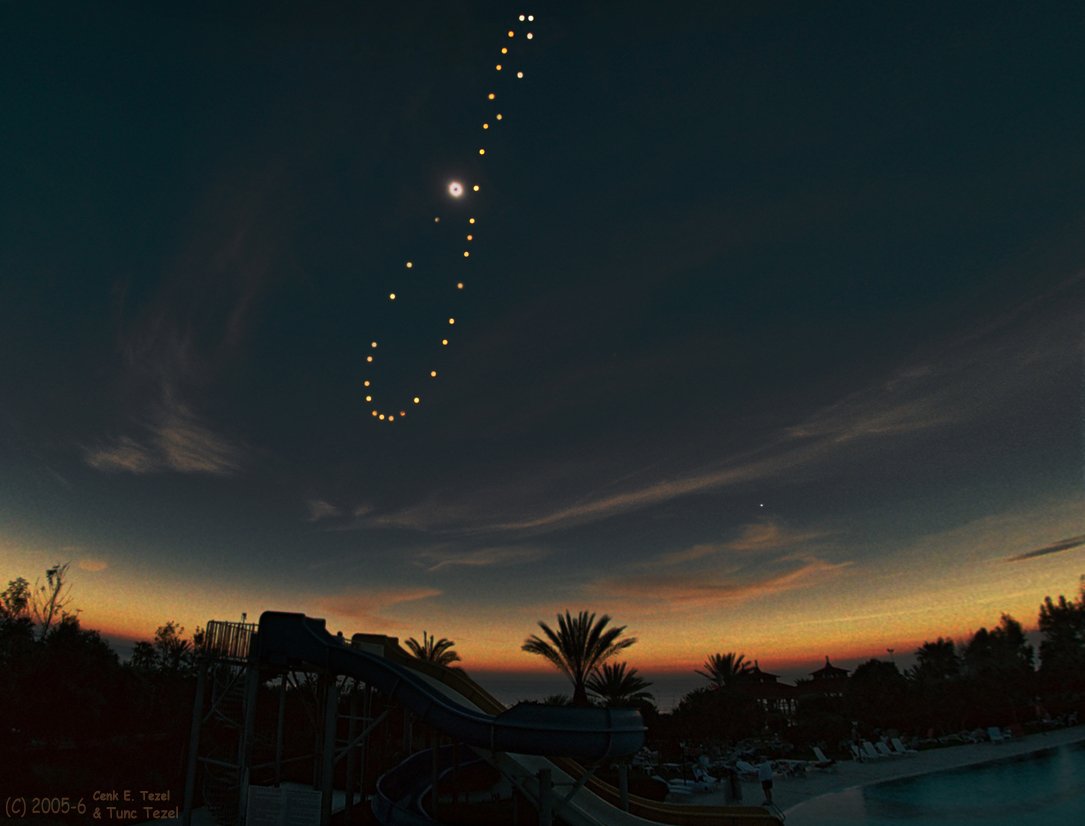
Analemma (actually a tutulemma) from NASA

Analemma (actually a tutulemma) from NASA

Links!

Pacific Science Center

U.S. Naval Observatory

Dark Days of Winter

Sun and Moon Data for One Day

Vocabulary Words!

Blerch. I used a lot of jargon in that podcast, but if you weren’t taking notes and remembered that there was a word somewhere in there that you wanted more info about, here are some of the main ideas.

Equation of Time

Analemma

Perihelion

Astronomical Noon

Tropic of Cancer

Tropic of Capricorn

Mean Solar Time

Apparent Solar Time

Meridian

Eccentricity

Today is also the first day of winter quarter, wish my students and me luck on our three-month journey.

~ A l i c e !

The ‘Cast